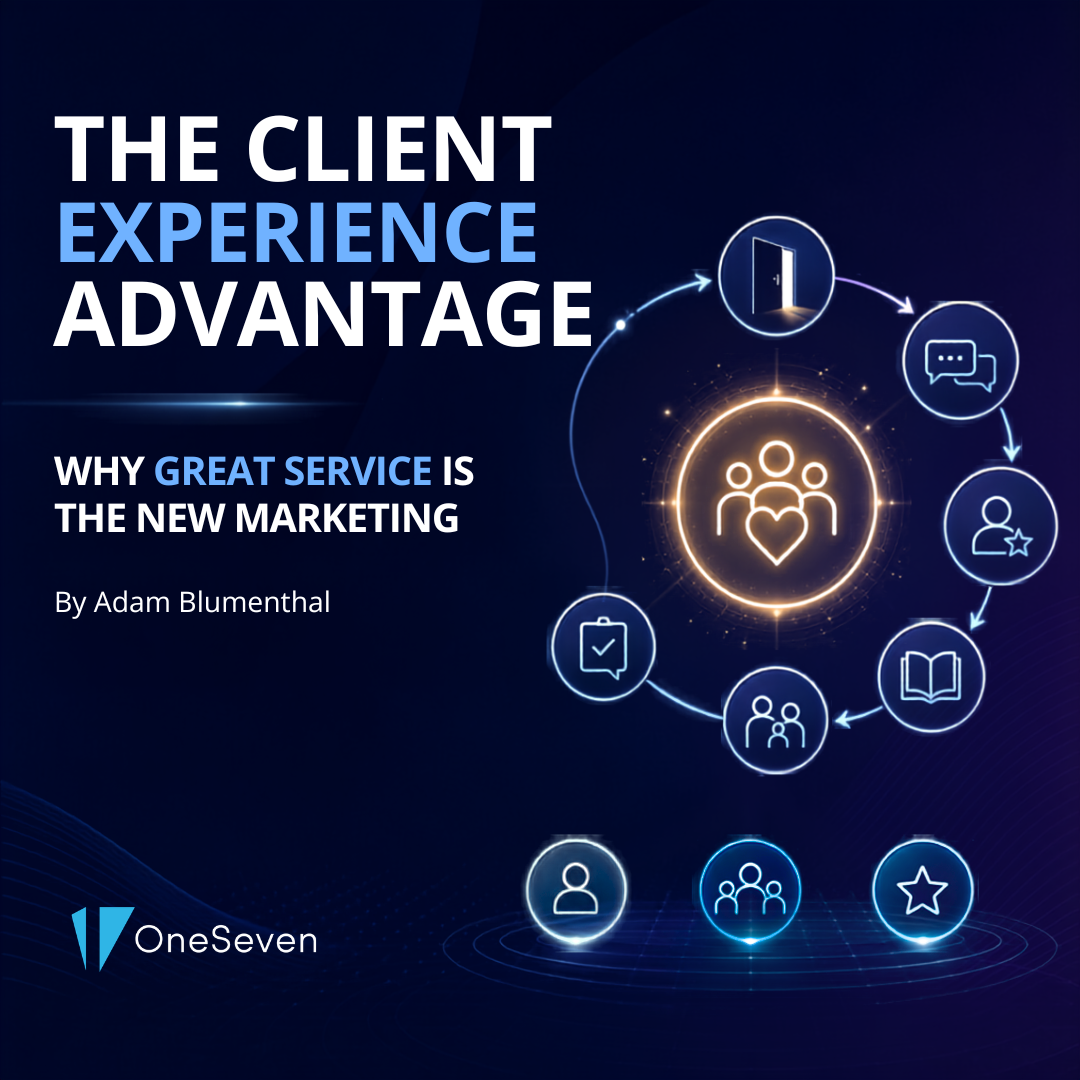
In today’s advisory landscape, exceptional client service isn’t just good business—it’s your most powerful marketing strategy.
By Adam Blumenthal, Chief Growth Officer at OneSeven
For decades, financial advisors competed on investment performance.
Then they competed on financial planning.
Today, nearly every successful advisory firm offers sophisticated planning, diversified portfolios, tax strategies, retirement planning, and estate coordination.
So what separates one advisor from another?
Increasingly, it’s the client experience.
The firms growing the fastest aren’t simply delivering great advice—they’re creating experiences that clients remember, recommend, and return to.
In a world where prospects can find financial information anywhere, the experience you create has become your greatest competitive advantage.
Clients Remember How You Made Them Feel
Think about the businesses you’re most loyal to.
It’s probably not because they have the absolute lowest prices.
It’s because they consistently make your life easier.
They communicate well.
They solve problems.
They exceed expectations.
Financial advice is no different.
Years from now, your clients may not remember the exact allocation of their portfolio.
But they’ll remember:
- How you helped them through a market downturn.
- The phone call after losing a loved one.
- The celebration when they sold their business.
- The encouragement before retirement.
- The confidence you gave them during uncertain times.
Those moments define relationships.
Every Interaction Shapes Your Brand
Many firms think branding happens through logos, websites, or advertising.
While those things matter, your true brand is built through every client interaction.
Consider every touchpoint.
Before becoming a client:
- Website experience
- Scheduling a meeting
- Response time
- Discovery meeting
- Follow-up communication
After becoming a client:
- Onboarding
- Review meetings
- Educational resources
- Client service
- Proactive communication
- Problem resolution
Each interaction either strengthens or weakens trust.
Marketing attracts prospects.
Experience keeps them.
The First 90 Days Matter Most
The onboarding process often determines the future of the relationship.
Many firms spend months winning a new client, then deliver a confusing onboarding experience.
Instead, create a process that makes clients feel confident from day one.
A great onboarding experience includes:
- A clear timeline
- Defined expectations
- Regular updates
- Easy-to-complete paperwork
- Welcome materials
- Introductions to the service team
- Immediate value
The goal isn’t simply transferring assets.
It’s reinforcing that the client made the right decision.
Proactive Beats Reactive
One of the easiest ways to differentiate your firm is through proactive communication.
Don’t wait until clients call.
Reach out first.
Examples include:
During market volatility:
“We wanted to check in before you saw today’s headlines.”
Before tax season:
“Here are a few planning opportunities to discuss with your CPA.”
As retirement approaches:
“We’re six months away from an important milestone. Let’s begin preparing now.”
After major legislation:
“Here’s what the recent tax changes may mean for your family.”
Clients appreciate advisors who anticipate needs before they become problems.
Personalization Wins
Technology has made personalization easier than ever.
Keep track of:
- Birthdays
- Anniversaries
- Children’s graduations
- Retirement dates
- Business milestones
- Charitable interests
- Hobbies
- Family updates
Imagine receiving a handwritten congratulations after selling your business.
Or a personal note when your grandchild is born.
Those moments create emotional loyalty.
Clients remember advisors who remember them.
Educate Continuously
The best advisors don’t communicate only during review meetings.
They teach throughout the year.
Examples include:
- Monthly newsletters
- Educational webinars
- Short videos
- Tax planning updates
- Market commentary
- Retirement checklists
- Estate planning reminders
Education builds confidence.
Confidence builds trust.
Trust builds long-term relationships.
Include the Entire Family
Many advisory relationships begin with one individual.
The strongest relationships eventually include the entire family.
Invite:
- Spouses
- Adult children
- Parents
- Future executors
- Business partners
These conversations strengthen succession planning while helping preserve assets across generations.
More importantly, they demonstrate that your concern extends beyond investment accounts.
You’re helping families—not just individuals.
Turn Clients Into Advocates
Happy clients stay.
Exceptional experiences create advocates.
There’s an important difference.
Advocates don’t simply remain clients.
They:
- Refer friends.
- Introduce colleagues.
- Bring family members.
- Invite you to speak.
- Recommend your firm to professionals.
Advocacy isn’t created by asking for referrals.
It’s created by consistently exceeding expectations.
Technology Should Enhance the Experience
Technology should never replace personal relationships.
It should make them stronger.
Use technology to:
- Schedule proactive reminders
- Deliver secure communications
- Simplify onboarding
- Track client milestones
- Share educational content
- Automate routine follow-up
Automation handles routine tasks.
People handle meaningful conversations.
That’s the right balance.
Ask for Feedback Before Problems Grow
Many firms assume clients are happy because they haven’t complained.
That’s a dangerous assumption.
Great firms actively seek feedback.
Ask questions like:
- How can we improve your experience?
- What’s one thing we could do better?
- Are there additional services that would be valuable?
- How satisfied are you with our communication?
Listening demonstrates humility.
Acting on feedback demonstrates commitment.
Every Employee Shapes the Client Experience
Client experience isn’t just the advisor’s responsibility.
Receptionists.
Client service associates.
Operations teams.
Marketing.
Compliance.
Leadership.
Every interaction contributes to the client’s perception of your firm.
One outstanding advisor cannot overcome a poor service experience elsewhere.
Culture matters.
Great Experiences Increase Enterprise Value
Exceptional client experiences don’t just improve retention.
They increase the value of your business.
Why?
Because firms with:
- High retention
- Strong referral rates
- Deep relationships
- Multi-generational households
- Predictable organic growth
Often command higher valuations than firms dependent solely on one advisor’s personal relationships.
Client experience is both a growth strategy and a business strategy.
Final Thoughts
Financial planning has become increasingly sophisticated.
Technology continues to evolve.
Investment management is more accessible than ever.
But one thing remains difficult to replicate:
A truly exceptional client experience.
When clients feel understood, appreciated, and confident, they stay longer.
They consolidate assets.
They introduce friends.
They become advocates.
The future belongs to firms that recognize client experience isn’t simply part of the business.
It is the business.
About OneSeven
At OneSeven, we believe great advisors deserve a platform that allows them to deliver extraordinary client experiences. From operational support and integrated technology to marketing, compliance, and practice management, we help advisors spend less time on administrative tasks and more time doing what matters most—building lasting relationships with clients. Because when advisors have the right support, clients receive the experience they deserve.