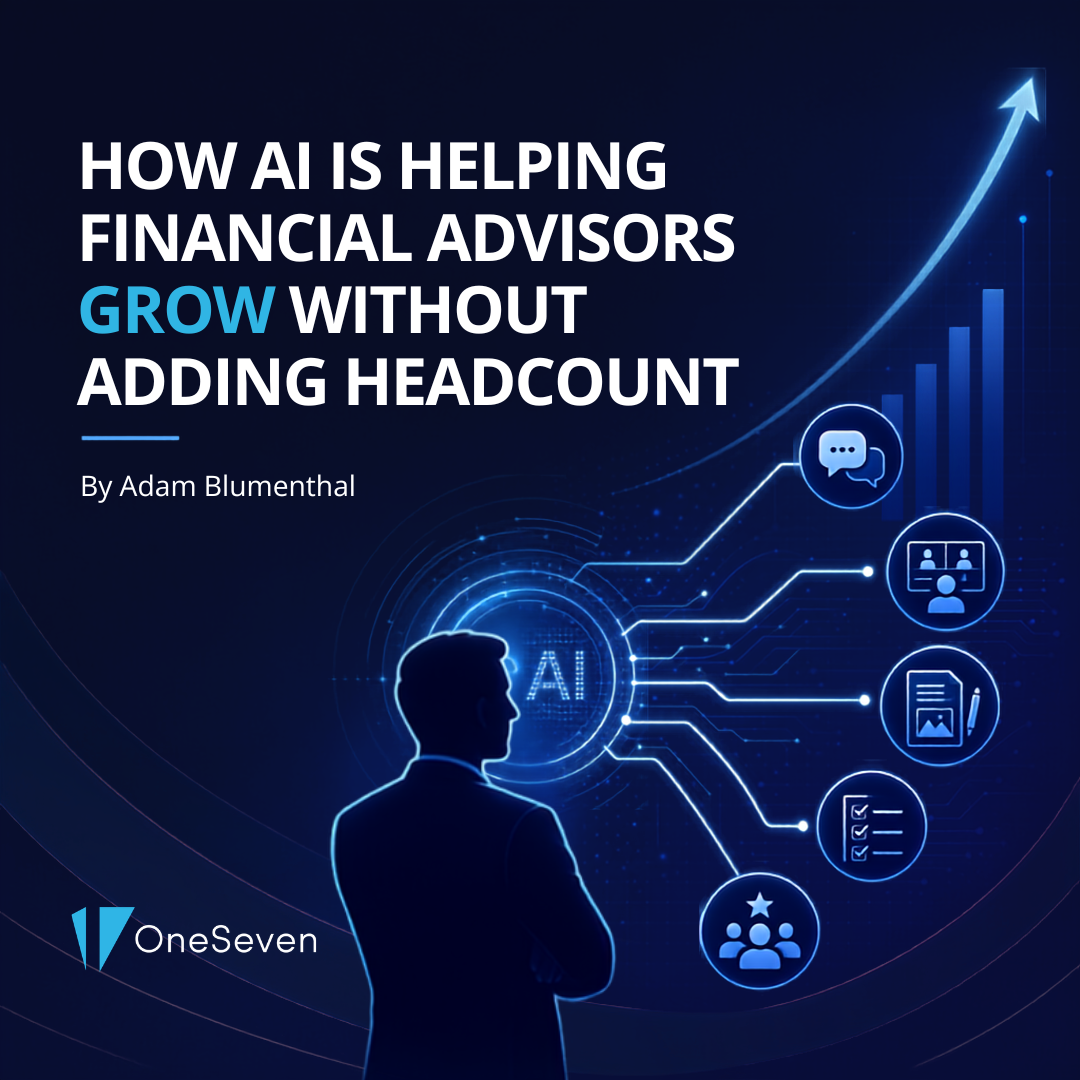
Artificial intelligence isn’t replacing financial advisors—it’s empowering them to serve more clients, operate more efficiently, and grow their businesses without growing their payroll.
By Adam Blumenthal, Chief Growth Officer at OneSeven
For years, advisory firms faced a familiar challenge: as the business grew, so did the need for additional staff. More clients meant more paperwork, more emails, more meeting preparation, more marketing, and more administrative work.
Today, that equation is changing.
Artificial intelligence is giving advisors something they can never buy more of—time.
The firms embracing AI aren’t replacing relationships with technology. They’re eliminating repetitive tasks so advisors can spend more time doing what clients value most: providing advice, building trust, and strengthening relationships.
If your goal is organic growth, AI may be the most impactful investment your firm makes over the next decade.
Here’s why.
AI Is a Productivity Tool, Not a Replacement
Let’s address the biggest misconception first.
Clients don’t hire advisors because they can calculate retirement projections or rebalance portfolios.
They hire advisors because they want:
- Confidence
- Perspective
- Accountability
- Emotional guidance
- Strategic planning
- A trusted partner during life’s biggest financial decisions
AI cannot replace those human qualities.
What it can replace is the administrative work that often keeps advisors from delivering more of them.
Think of AI as a highly capable assistant that never gets tired, works around the clock, and handles repetitive tasks in seconds.
Where Advisors Gain the Most Time
The biggest opportunities aren’t flashy.
They’re practical.
1. Content Creation
One of the greatest barriers to consistent marketing is simply finding time.
AI can help advisors generate first drafts of:
- Blogs
- LinkedIn posts
- Client newsletters
- Educational articles
- Webinar outlines
- Market commentary
- Frequently asked questions
Instead of staring at a blank screen for an hour, advisors can begin with a strong draft and personalize it with their own expertise and voice.
The result is more consistent communication with significantly less effort.
2. Meeting Preparation
Preparing for client meetings often involves reviewing notes, researching accounts, and gathering relevant planning opportunities.
AI can assist by organizing information into concise summaries, highlighting important client milestones, and suggesting discussion topics based on previous conversations.
Rather than spending 30 minutes preparing for each meeting, advisors can walk in informed and focused.
3. Meeting Notes and Follow-Up
Many advisors spend nearly as much time documenting meetings as they do conducting them.
Modern AI tools can:
- Summarize conversations
- Capture action items
- Draft follow-up emails
- Organize CRM notes
- Identify planning opportunities
Instead of spending valuable time typing notes after every meeting, advisors can focus on their next client conversation.
4. Email Productivity
Email consumes a surprising portion of the workday.
AI can help:
- Draft professional responses
- Summarize lengthy email threads
- Improve tone and clarity
- Personalize client communications
- Translate technical concepts into plain language
Advisors remain in control of every message, but they spend far less time creating them.
5. Marketing at Scale
Growing firms need consistent visibility.
AI makes it possible to create one piece of content and repurpose it into multiple formats.
For example:
One webinar becomes:
- A blog
- Five LinkedIn posts
- A client newsletter
- Short educational videos
- Social media graphics
- Frequently asked questions
- Email campaigns
Instead of creating everything from scratch, advisors maximize the value of every idea.
AI Helps Smaller Firms Compete Like Larger Firms
Historically, enterprise firms had an advantage because they employed large marketing departments, operations teams, and administrative staff.
Today, AI levels the playing field.
A five-person advisory firm can produce content, automate workflows, and enhance client communications in ways that once required an entire department.
Technology has become a force multiplier.
It enables smaller firms to appear larger while maintaining the personalized service clients appreciate.
Better Client Experiences
AI isn’t just about efficiency.
It’s also improving the client experience.
Imagine automatically reminding advisors about:
- Client birthdays
- Retirement anniversaries
- Required minimum distributions
- Tax deadlines
- College planning milestones
- Business succession timelines
These proactive touchpoints demonstrate attentiveness without relying solely on memory.
Clients notice.
AI Can Improve Compliance Too
One of the biggest concerns surrounding AI is compliance.
That’s understandable.
But when implemented thoughtfully, AI can actually strengthen compliance processes.
Many firms are using AI to:
- Review marketing materials before submission
- Standardize communication
- Improve documentation
- Organize compliance workflows
- Assist with recordkeeping
- Identify missing disclosures
The key is ensuring that every AI-generated communication is reviewed according to your firm’s compliance policies before it’s shared externally.
AI should support compliance—not bypass it.
What Advisors Should Never Delegate to AI
As powerful as AI has become, there are areas where advisors should remain firmly in control.
These include:
- Investment recommendations
- Fiduciary decision-making
- Emotional client conversations
- Complex financial planning
- Ethical judgment
- Relationship management
- Final approval of client communications
Technology can accelerate your work.
It cannot replace your judgment.
Getting Started Doesn’t Have to Be Complicated
Many advisors hesitate because they believe implementing AI requires expensive software or major operational changes.
In reality, the best approach is to start small.
Choose one repetitive task.
For example:
- Drafting weekly LinkedIn posts
- Summarizing meetings
- Creating first drafts of blogs
- Writing client emails
- Building educational presentations
Master one workflow before adding another.
Small productivity gains compound over time.
The Competitive Advantage Is Time
Every advisor has the same 24 hours in a day.
The difference is how those hours are spent.
Without AI:
- More administrative work
- Less client interaction
- Inconsistent marketing
- Slower growth
With AI:
- More client conversations
- Better marketing
- Faster execution
- Increased consistency
- Greater capacity without increasing payroll
That’s a meaningful competitive advantage.
The Future Belongs to Advisors Who Embrace Technology
The firms leading the next decade won’t necessarily be those with the largest offices or biggest marketing budgets.
They’ll be the firms that combine exceptional human advice with intelligent technology.
Clients still want trusted advisors.
They simply expect those advisors to deliver a more responsive, personalized, and efficient experience.
Artificial intelligence makes that possible.
Not by replacing advisors.
By making great advisors even better.
Final Thoughts
AI is no longer a futuristic concept—it’s a practical tool that’s already reshaping the advisory profession.
The question isn’t whether AI will change wealth management.
It already has.
The real question is whether your firm will use it to create a competitive advantage.
Advisors who embrace AI thoughtfully can expand their capacity, improve the client experience, strengthen their marketing, and build more scalable businesses—all without sacrificing the personal relationships that define exceptional financial advice.
The future of wealth management isn’t human or AI.
It’s human plus AI.
About OneSeven
At OneSeven, we believe innovation should make advisors more effective—not more complicated. We help advisory firms leverage technology, AI, marketing, and operational support to create scalable growth while preserving the personalized service clients expect. By combining human expertise with intelligent tools, advisors can spend less time on administrative work and more time building lasting relationships.
Key Takeaways
- AI enhances advisors—it doesn’t replace them.
- The biggest productivity gains come from automating repetitive tasks.
- AI enables consistent marketing without adding headcount.
- Meeting preparation, note-taking, and follow-up can be dramatically streamlined.
- Smaller firms can compete more effectively with larger enterprises.
- AI can strengthen compliance when used within a governed framework.
- Advisors should always retain responsibility for advice, judgment, and client relationships.
- Firms that thoughtfully adopt AI today will be better positioned for sustainable growth tomorrow.