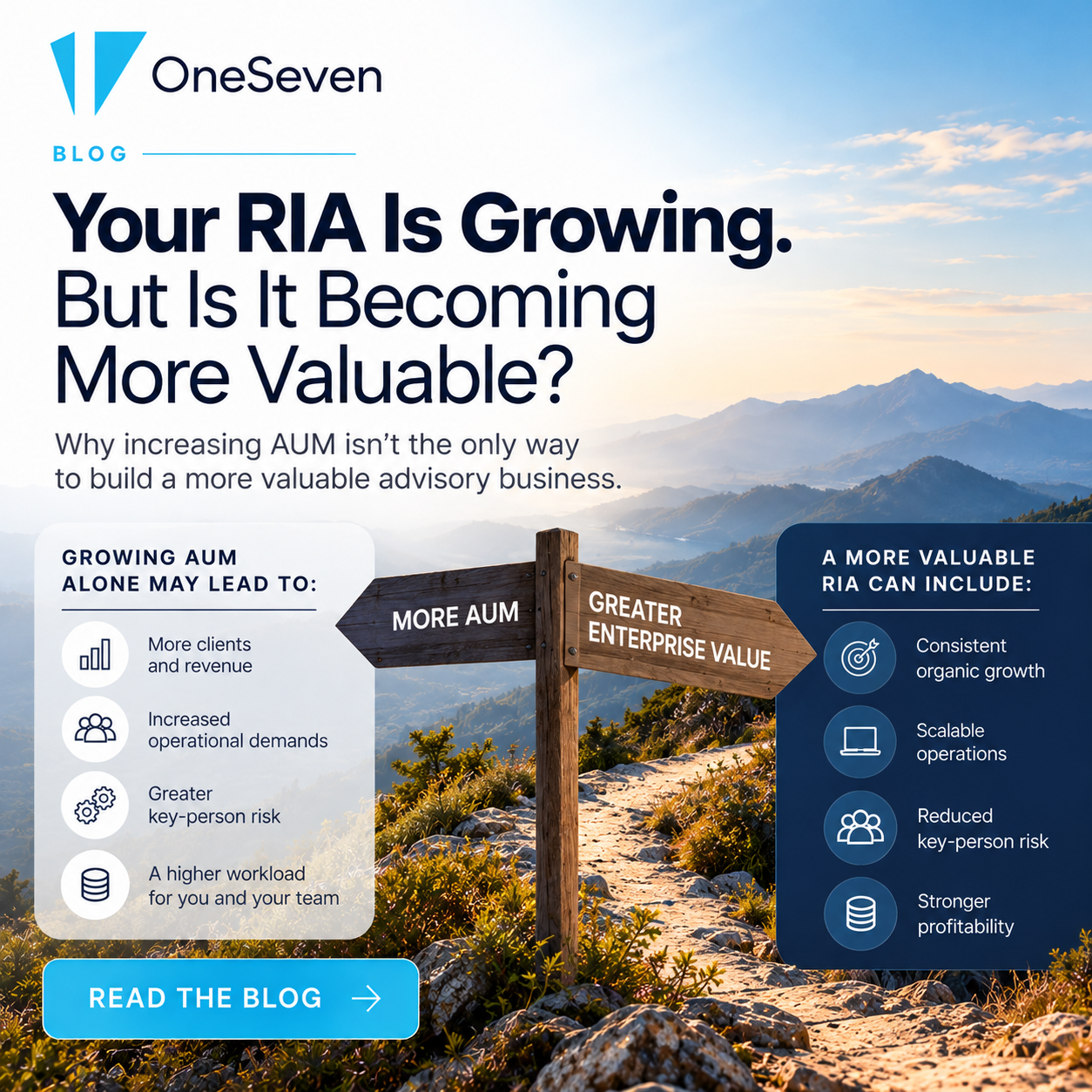
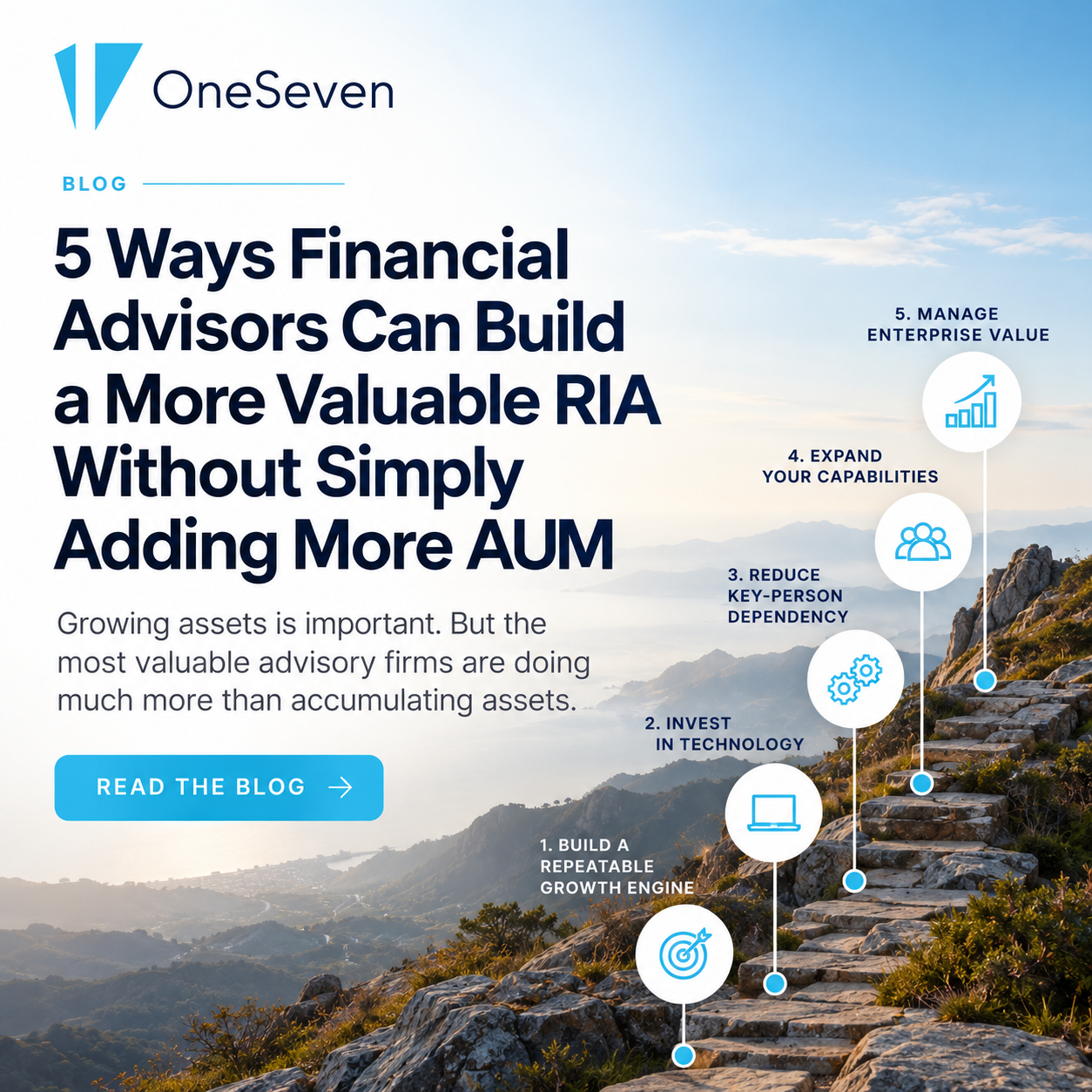
Growing assets is important. But the most valuable advisory firms are doing much more than accumulating assets.
Ask a financial advisor how they plan to grow their business, and the answer will often center around one metric: assets under management.
More clients. More assets. More revenue.
While those goals remain essential, the RIA industry’s evolving valuation landscape suggests that AUM growth alone is no longer enough to maximize enterprise value.
Buyers are increasingly evaluating the quality, scalability, and sustainability of an advisory business.
That means financial advisors who want to build more valuable firms need to think beyond traditional growth metrics.
Here are five strategies worth prioritizing.
- Build a Repeatable Organic Growth Engine
Referrals are an important source of new business for many financial advisors.
But relying entirely on referrals can make growth difficult to predict.
A scalable advisory business benefits from a more intentional approach to business development.
That may include defining an ideal client profile, developing targeted marketing campaigns, strengthening referral relationships, and implementing systems to track prospect engagement.
The objective isn’t simply to generate more leads.
It’s to create a consistent process for attracting, engaging, and converting the right prospective clients.
A repeatable growth strategy can make future revenue more predictable and demonstrate that the business has opportunities beyond its existing relationships.
- Invest in Technology That Makes Your Team More Efficient
Technology should do more than help advisors complete everyday tasks.
It should create operational capacity.
Consider the difference between a firm that relies on disconnected spreadsheets, manual processes, and individual employee knowledge and one that uses integrated systems to manage client relationships, workflows, and communications.
The second firm may be better positioned to serve additional clients without increasing overhead at the same rate.
CRM systems, workflow automation, integrated reporting, and centralized client information can all support a more scalable operating model.
The key is ensuring technology improves the way the business functions rather than simply adding more tools.
- Reduce Key-Person Dependency
If you stepped away from your practice for 30 days, what would happen?
Would client service continue smoothly?
Would your team know how to manage outstanding responsibilities?
Would business development continue?
Or would critical processes come to a halt?
A business that depends entirely on its founder may face greater operational and succession risks.
Documenting processes, delegating responsibilities, developing team members, and establishing consistent service standards can help reduce that dependency.
These changes also support long-term continuity for clients and employees.
- Expand Your Capabilities Without Expanding Your Workload
Growth doesn’t always require doing more yourself.
In fact, attempting to personally manage every new service, client need, and operational function can limit an advisor’s capacity.
Strategic partnerships can provide access to specialized expertise, advanced technology, investment solutions, and business development resources without requiring advisors to build everything internally.
For example, centralized marketing support may help an advisor reach new prospects while allowing the advisor to remain focused on client relationships.
The same principle applies to compliance, operations, and other business functions.
The goal is to expand what your firm can accomplish without proportionally expanding your personal responsibilities.
- Start Managing Enterprise Value, Not Just Revenue
Revenue tells you how much money your business generates.
Enterprise value reflects a broader assessment of the business’s future economic potential, risks, and transferability.
That distinction matters.
An RIA with strong revenue but inconsistent processes, limited growth infrastructure, and significant founder dependency may be viewed differently from one with a scalable operating model.
As OneSeven’s The 20x Multiple Reality whitepaper explains, buyers increasingly consider organic growth, operational infrastructure, specialized client solutions, and business structure when evaluating advisory firms.
Advisors should therefore monitor more than AUM and revenue.
Growth consistency, profitability, operating efficiency, client retention, and succession readiness can all help inform the bigger picture.
The Next Stage of Growth Requires a Different Mindset
Building a successful RIA and building a scalable enterprise aren’t always the same thing.
The strategies that helped an advisor reach their first $100 million or $500 million in AUM may not be sufficient to support the next stage of growth.
That doesn’t mean abandoning what made the business successful.
It means creating the infrastructure necessary to build on that success.
At OneSeven, we help financial advisors access the technology, marketing, operational support, and strategic resources needed to pursue sustainable growth.
Because building a more valuable business isn’t just about how much you grow. It’s about how you grow.
Explore how OneSeven supports advisor growth at OneSevenAdvisor.com.