By Adam Blumenthal, Chief Growth Officer, OneSeven
Fidelity’s recent announcement that RIAs must maintain at least $100 million on its custody platform by June 30, 2027, or find another custodial relationship, should be a wake-up call for every independent RIA owner.
But I believe the industry is missing the bigger story.
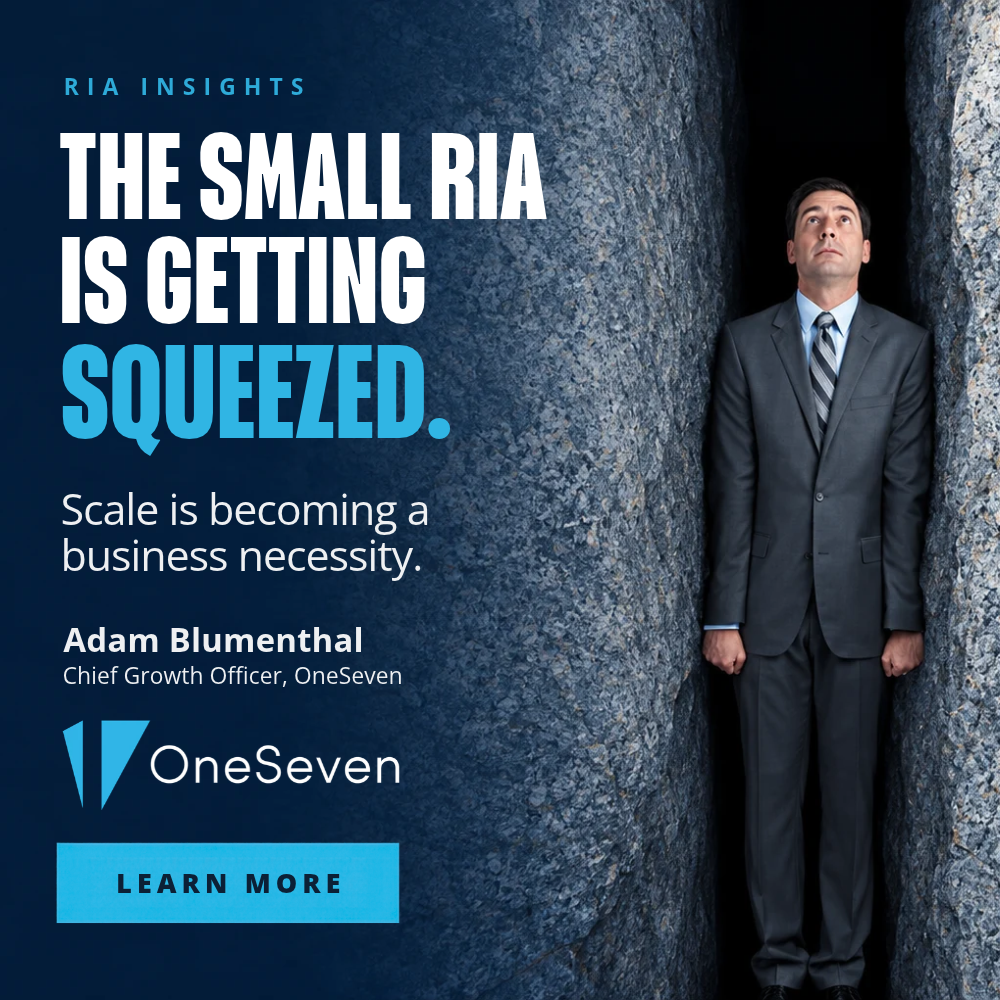
This isn’t really about Fidelity. It’s about the growing challenges of being a small fish in a very big pond.
For years, the independent RIA model has been celebrated for its entrepreneurial freedom, flexibility, and ability to put clients first. And rightfully so. But the economics of running a smaller independent RIA are becoming increasingly challenging.
Fidelity’s decision is simply the latest example of a much larger trend: Scale is becoming less of a competitive advantage and more of a business necessity.
The Hidden Risks of Being a Small RIA
Consider the challenges facing an independent RIA managing $50 million, $75 million, or even $150 million today.
- Operational Risk Is Increasing
When you’re a smaller firm, you’re often dependent on a handful of employees, technology providers, and custodial relationships. One unexpected change can create enormous disruption. Fidelity’s announcement is a perfect example. A decision made by a large institution can suddenly force a small business owner to rethink a critical part of their operations.
- Economies of Scale Are Working Against You
Compliance, technology, cybersecurity, insurance, and administrative expenses continue to demand investment. Larger organizations can spread these costs across billions of dollars in assets. Smaller RIAs must absorb many of those same expenses across a fraction of the revenue.
- Compliance and Technology Are Becoming More Complex
Regulatory expectations, cybersecurity requirements, AI adoption, and client reporting capabilities are raising the bar. Advisors need increasingly sophisticated infrastructure just to remain competitive. The challenge isn’t simply paying for these resources. It’s finding the time and expertise to implement and manage them.
- Delivering Ritz-Carlton-Level Service Is Getting Harder
Clients expect more than investment management. They want proactive communication, comprehensive planning, personalized experiences, and immediate access to answers.
But when the advisor is also the CEO, compliance coordinator, technology manager, and head of operations, something eventually gives.
Too often, it’s the time available to deliver the exceptional client experience that built the business in the first place.
- Organic Growth Becomes an Afterthought
This may be the biggest missed opportunity.
Most independent advisors are excellent at serving clients. Far fewer have the time, resources, or expertise to build a predictable marketing and business development engine.
When you’re consumed with running the business, it’s difficult to focus on growing the business.
Referrals alone may not be enough to sustain meaningful long-term growth.
The Biggest Risk? Your Enterprise Value.
Here’s what I believe every RIA owner needs to understand.
These challenges don’t just affect your profitability today. They can directly impact what your business is worth tomorrow.
Think about it from a buyer’s perspective.
Would you pay the same multiple for a firm with concentrated operational risk, rising expenses, limited infrastructure, an aging client base, and little organic growth as you would for a firm with scalable operations, predictable growth, strong margins, and institutional-quality resources?
Of course not.
Buyers aren’t simply purchasing assets under management. They’re evaluating the sustainability, profitability, growth potential, and risk of the business.
A smaller RIA may have spent 20 or 30 years building an incredible practice, only to discover that the lack of scale has become a meaningful obstacle to maximizing its enterprise value.
Independence Doesn’t Have to Mean Going It Alone
I don’t believe the solution is for every small RIA to sell its business or give up its identity.
In fact, I believe the opposite.
The next evolution of independence is finding ways to maintain your entrepreneurial freedom while accessing the scale, infrastructure, and resources of a much larger organization.
At OneSeven, this is a philosophy we’ve embraced. Advisors can maintain their name, brand, and client relationships while benefiting from a larger RIA platform, multi-custodial relationships including Fidelity, Schwab, and Goldman Sachs, and dedicated resources designed to support organic growth.
The goal isn’t to take away independence. It’s to make independence more sustainable and valuable.
The Bottom Line
Fidelity’s $100 million decision may be making headlines today, but the underlying challenges facing smaller RIAs have been building for years.
The real question for independent RIA owners isn’t simply, “Where will I custody my assets?”
It’s much bigger:
“Am I building a business that will become more valuable over the next five to ten years—or am I allowing the increasing costs and complexities of independence to slowly erode what I’ve spent my career building?”
Because in today’s wealth management industry, staying independent and staying small are no longer necessarily the same thing.
And the advisors who recognize that distinction may be the ones who build the most valuable businesses of tomorrow.
Is OneSeven your solution? Explore your opportunities with a confidential conversation.